Marta
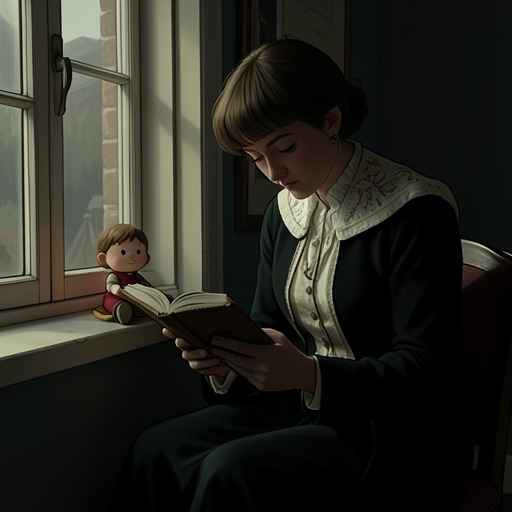
The Lost DaughterMarta is Leda and Gianni’s younger daughter, born into a family in which maternal care is both an everyday responsibility and a source of strain. Her story is told largely through Leda’s memories and judgments: Marta is first the child whose needs interrupt Leda’s time with Bianca, later a daughter caught in her mother’s departure, and finally one of two adult children whose relationship with Leda is expressed through calls, requests, and careful comparisons. The account gives little access to Marta’s private thoughts, but the scenes Leda recalls show how separation and unequal-feeling care remain part of their family life.
Identity and Early Family Life
Leda describes Marta as the second child she planned to have after Bianca. People around the couple believed Bianca should not grow up without a sibling, and Leda says she accepted that expectation and planned for Marta soon after her first daughter’s birth. She was twenty-five. In retrospect, Leda places this decision alongside an account of pregnancy as a bodily experience that could feel both part of her life and separate from her, but she does not present Marta as unwanted: rather, she remembers making a deliberate choice under the influence of an accepted idea about what Bianca needed.
The practical realities of caring for two small children quickly became difficult. Marta did not sleep at night, and when she slept during the day it was only briefly. Leda recalls being tired while Bianca remained near her, full of demands and unwilling to attend day care. When Marta began crying in another room, Leda would leave Bianca’s game to attend to her. She felt an almost immediate release from the first child’s demands, then justified the interruption to herself by thinking that it was Marta, not Leda, who was pulling her away. Bianca cried as Leda left. In this memory, Marta is not blamed for needing care; instead, the episode shows how Leda’s exhaustion made ordinary acts of caregiving feel like a painful division of attention.
Childhood and the Household’s Uneven Pressures
Leda’s recollections of the sisters reveal sharply different responses to her. In one game, Bianca pretended to care for Leda under a kitchen table, while Leda, exhausted, tried to participate. The scene ends when Marta’s crying calls her away. Leda remembers wanting to be a good mother, yet feeling desolate and unable to study or play with pleasure. Marta’s needs become the immediate cause of an interruption, but Leda’s narration also makes clear that the larger pressure comes from her own depleted state and from trying to meet both children’s demands.
As Marta grew older, Leda interpreted her as more fragile than Bianca. When Marta brought her friend Florinda home, Leda became angry at the muddy floors and crumbs the girls left behind and ordered Florinda to clean them. Marta watched while Florinda did so. Afterward, Marta shut herself in her room and would not speak to Leda for days. Leda contrasts this withdrawal with Bianca’s more combative manner: Marta, in her account, retreats when the tone changes rather than arguing back. Florinda gradually disappeared from Marta’s life, and Leda later found that asking about the friend drew only a vague response or a shrug. The episode shows a consequence that Leda notices but does not repair: her authority in the household has helped drive a friendship out of her daughter’s life.
The Departure and Its Aftermath
When Leda decided to leave, Bianca and Marta approached her together with an orange and asked her to make the peel into a snake. They sat in their new dresses and waited, expecting a small familiar act from their mother. Leda made the snake, but her attention was fixed on the possibilities she imagined beyond the household: work, new forms of life, and a language she wanted to claim as her own. She left after finishing the orange. For the next three years, she neither saw nor heard her daughters.
Leda’s absence did not mean that Marta and Bianca were always apart from their maternal relatives. Leda had feared that Gianni might take the girls to Naples and leave them with her mother and family there; during periods when work or travel overwhelmed him, he did take them to the apartment where Leda had grown up, sometimes for months. Leda says he otherwise cared for the girls, but she remained distressed by their exposure to the family and city from which she had tried to escape. She later reclaimed her daughters and brought them to Florence. Her account also records that she accused her own mother of having marked the girls as she believed she herself had been marked. The accusation damaged that relationship, and Leda acknowledges it as unjust. Marta’s experience of this period is filtered through Leda’s fears and retrospective guilt, rather than recounted directly by Marta.
Adulthood and the Measure of Care
After Marta and Bianca moved to Toronto, where their father had long lived and worked, Leda was surprised by her own relief. She no longer felt responsible for the daily tasks of shopping, laundry, and managing the household, and the distance made direct intervention impossible. She called the girls daily to ask how they were. They often spoke as if they were on their own, while keeping their father out of their conversations with Leda. Their calls could be hurried or evasive, and they also contacted her with practical requests.
Leda remembers Marta asking her to send Bianca’s notes, then objecting that Leda had forgotten something Marta herself had requested. She connects such exchanges to a longer pattern of comparison between the sisters. As children, they had kept track of toys, sweets, and the number of kisses each received; later, their comparisons extended to clothes, vehicles, and money. Leda believes they suspect she gives one more than the other and maintain a private account of what each has received. She also fears that they may eventually regard her mainly as a material inheritance to be divided. These are Leda’s interpretations, not Marta’s stated explanations, but they show how practical assistance has become entangled with the daughters’ doubts about whether their mother’s affection is dependable.
The Final Call and Narrative Role
On a night when Leda considers calling her daughters but decides against it, she imagines that the conversation will turn into another list of needs and another chance for one sister to feel overlooked. The thought leaves her angry and unsettled; the distance has freed her from daily childcare without making the relationship emotionally simple. Later, after a difficult encounter with Nina, Leda is preparing to leave when her phone rings. She sees Marta’s name and answers. Bianca and Marta speak together, jokingly asking why their mother has not called and whether she will at least tell them if she is alive or dead. Leda responds that she is dead but fine.
The brief exchange does not settle the history between mother and daughters. Its humor draws on the distance and missed calls that Leda has described, while the fact that she feels contentment at seeing Marta’s name signals the continuing force of the bond. Marta’s narrative role is therefore not that of a fully independent viewpoint character; she appears through Leda’s memories, her mother’s judgments, and the practical and affectionate obligations that persist across separation. The final call leaves those obligations intact, without turning them into a simple reconciliation.